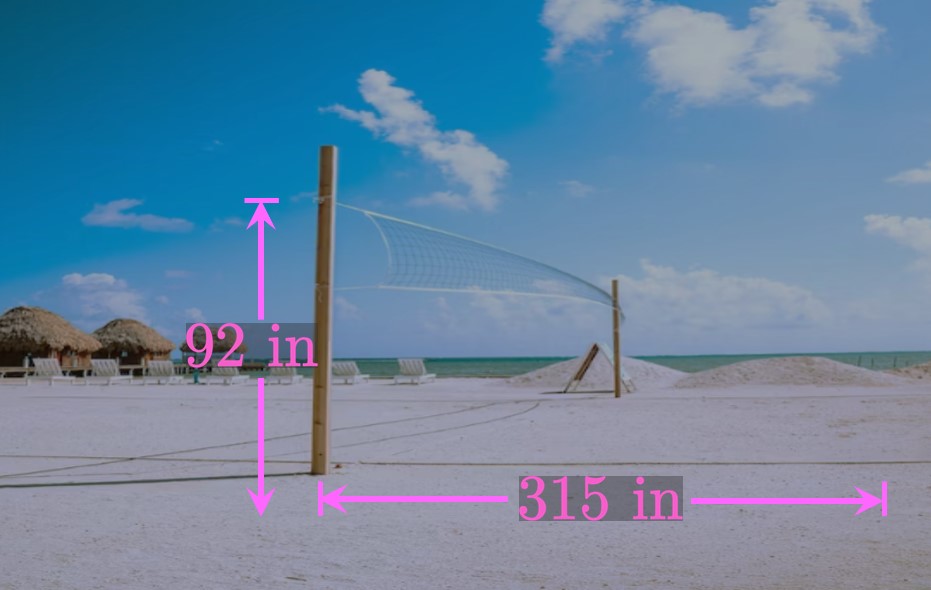
In volleyball, a player serves the ball by hitting it upward
and over the net,
which is about \(92\) inches above the ground and \(315\) inches away from the serving player
(Figure 1).
Suppose that a \(6\)-foot serving player hits the ball at head level straight
toward the net with a speed of \(880\)
inches per second at some angle \(\alpha\)
above the ground.
In terms of \(\alpha,\) write parametric equations for the volleyball's motion.
(Note: \(g\) = \(386\) inches per second squared.)
Model the shape of the ball's trajectory.
Find the values of \(\alpha\) such that the volleyball is successfully served.
On a flat field, a football is kicked upward and lands a distance \(D\)
away. (We call \(D\) the range.)
Find the angle above the horizontal at which the football should be kicked to maximize
the range.
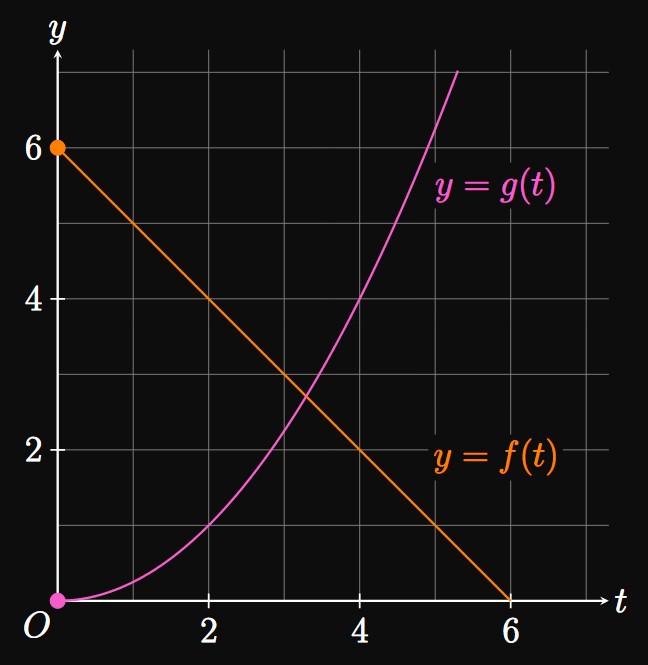
A curve \(C\) is parameterized by \(x = f(t)\) and \(y = g(t)\)
for \(0 \leq t \leq 6.\)
Figure 2 shows the graphs of \(f(t)\) and \(g(t),\)
where \(f\) is linear and \(g\) is quadratic.
Find the identity of \(f(t).\)
Find the identity of \(g(t).\)
By eliminating the parameter, represent \(C\)
using a Cartesian equation.
Sketch the curve \(C.\)
Draw arrows to indicate the direction
in which \(C\) is traced as \(t\) increases from \(0.\)
Show that the unbounded region
in the first and fourth quadrants enclosed between the \(y\)-axis and the
curve with parameterization \(x = t \cos t\) and \(y = \ln t\) has area \(1.\)
On the roof of a \(20\)-meter building,
a woman kicks a ball up and away from the building with an initial velocity of
\(16\) meters per second
directed \(45 \degree\) above the horizontal.
Calculate the maximum height the ball reaches.
The shape of a horse racetrack is given by the polar graph
\(r = 2 + 2 \cos \theta,\) where \(r\) is measured in meters.
A bell tower is located at the pole.
A horse runs counterclockwise along the track at a constant angular speed of
\(8\) radians per minute.
When \(\theta = 3 \pi/2,\)
is the horse moving toward or away from the bell tower?
A curve parameterized by \(x = f(t)\) and \(y = g(t)\)
passes through the point \((1, 3)\) when \(t = 2\) and satisfies
\[\deriv{y}{x} = \frac{3t^2 - 6t + 2}{2t - 4} \pd\]
Find one possible set of identities for \(f\) and \(g.\)
A particle travels counterclockwise along the cardioid \(r = 1 + \sin \theta,\)
where \(r\) is measured in inches,
with an angular speed of \(4\) radians per minute.
In square inches per minute, find the rate at which the particle sweeps out area with respect to the pole
when the particle is located \(\pi/6\) radians counterclockwise from
the positive \(x\)-axis.
A cannonball is launched upward with an initial speed of \(20\) meters per second
at an angle of \(57 \degree\) from the horizontal, on a platform \(10\) meters above the ground.
Calculate the length of the cannonball's trajectory until it hits the ground.
A projectile is fired such that its distance from the launch point
is always increasing.
Ignoring air resistance, calculate the maximum angle above the ground at which the projectile
could have been launched.