Under the influence of damping (a gradual dissipation of energy),
a vibrating object's position varies with time \(t \geq 0\) according to
\[x(t) = C e^{-4t} \cos(4t - \phi) \cma\]
where \(C \gt 0\) is the amplitude and \(\phi\) (phi) is the phase angle.
Find \(C\) and \(\phi\) (where \(0 \leq \phi \leq 2 \pi\))
such that the object begins at rest with an initial position of \(0.1.\)
Quadratic cost functions are highly applicable in economics.
A manufacturing plant decides to model its cost using a quadratic function.
The plant's overhead costs—the costs not associated with production,
such as in purchasing a location—are \(\$500.\)
If the total cost to produce \(100\) units is \(\$700,\)
and the total cost to produce \(200\) units is \(\$950,\)
then find the identity of the plant's cost function.
Use this function to predict the total cost to produce \(300\) units.
Let \(p\) be a twice-differentiable function.
Let \(q\) be a twice-differentiable function defined by
\[q(x) = \frac{2[p(x)]^3 + 4}{x^2 - 6x}\]
that satisfies \(\lim_{x \to 0} q(x) = 12.\)
It is known that \(\lim_{x \to 0} q(x)\) can be evaluated using L'Hôpital's Rule.
Find \(p(0)\) and \(p'(0).\)
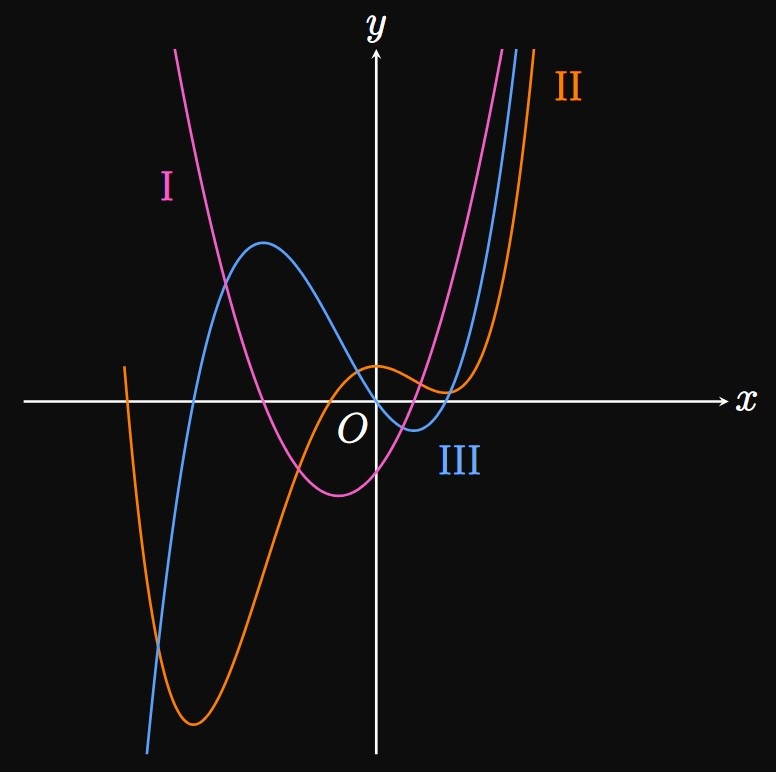
Determine all the solutions to the equation
\[x^3 + e^x = 1 \pd\]
(Hint: First find a solution by inspection;
then prove that no other solutions exist.)
At \(3\) pm,
Car A arrives at an intersection and heads due north at \(45\) miles per hour.
Car B travels due east at \(55\) miles per hour and arrives at the same intersection at
\(4\) pm.
Each car maintains its speed and direction.
Find the time after \(3\) pm
during which the two cars are closest together.
Let \(f\) and \(g\) be continuous functions such that \(f'(x) \gt g'(x)\) on \((a, b).\)
If \(f(a) = g(a),\)
then use the Mean Value Theorem to show that \(f(b) \gt g(b).\)
Use this result to show that \(x \gt \sin x\) for \(0 \lt x \lt 2 \pi.\)
In the movie Mean Girls (2004),
Cady and her opponent face immense pressure during the tiebreaker in a mathematics competition,
in which the two girls were given the limit
\[\lim_{x \to 0} \frac{\ln(1 - x) - \sin x}{1 - \cos^2 x} \pd\]
After her opponent's incorrect guess of \(-1,\)
Cady wins the competition by blurting: The limit does not exist.
Is Cady truly correct?
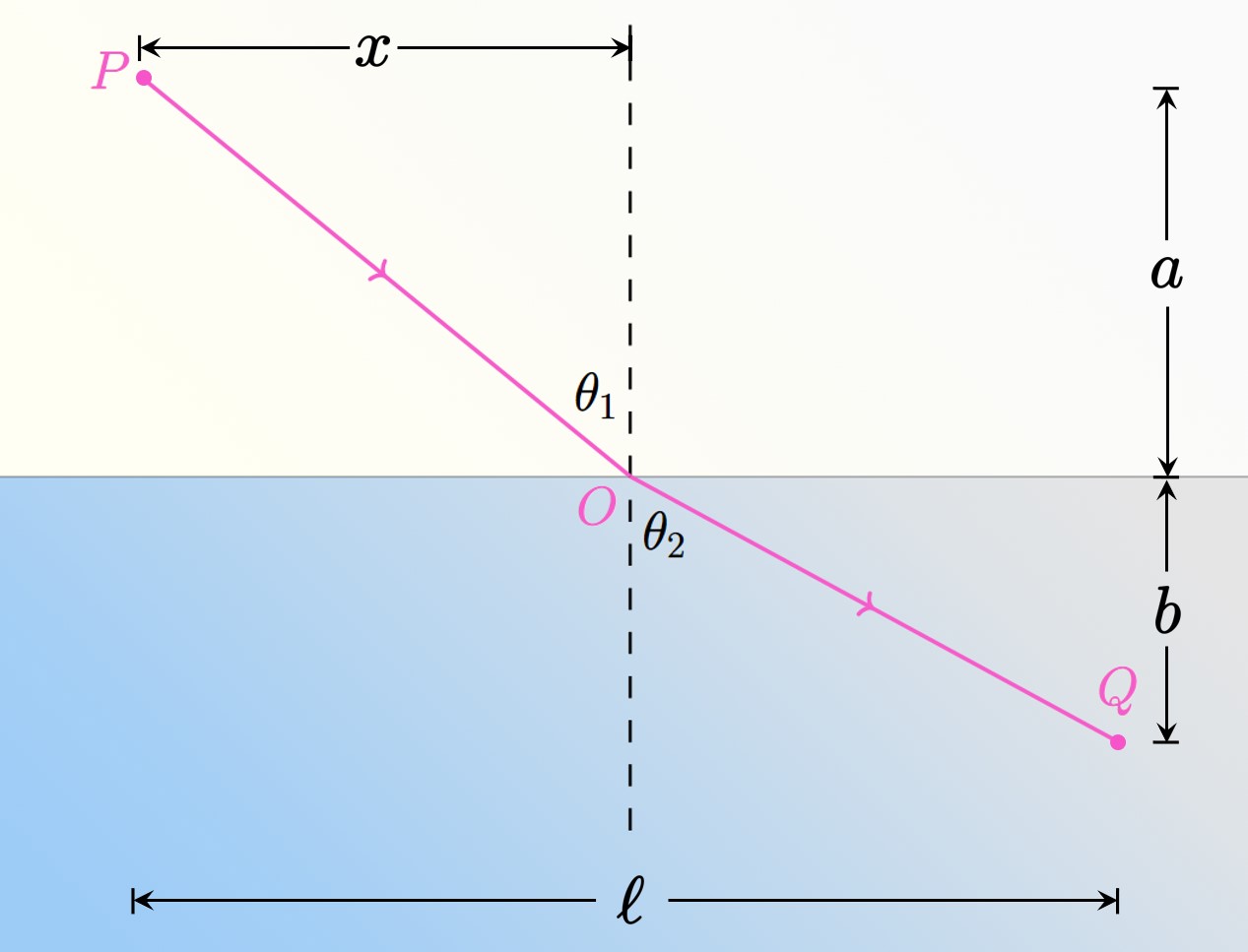
In Figure 2,
a ray of light starts in the air at point \(P,\)
is refracted into a medium of water at point \(O,\)
and travels to point \(Q.\)
Fermat's Principle states that the light ray follows the fastest route to point \(Q.\)
Let \(v_1\) be the light's speed in air and \(v_2\) be its speed in water.
Show that
\[\frac{\sin \theta_1}{v_1} = \frac{\sin \theta_2}{v_2} \pd\]
This formula is Snell's Law, a fundamental equation in the study of optics.