The quantity \(Q\) increases with \(t\) at a rate
directly proportional to the cube of \(Q\) and inversely proportional to the square of \(t.\)
When \(Q = 4\) and \(t = 2,\) the rate of change of \(Q\) with \(t\) is \(8.\)
Express \(Q\) as a function of \(t.\)
A function \(f\) satisfies \(f(a + b) = f(a) f(b)\) with \(f(0) = 1\) and \(f'(0) = k,\)
where \(k \ne 0.\)
Show that \(f'(x) = k f(x)\) for all \(x.\)
Determine the identity of \(f.\)
The property \(f(a + b) = f(a) f(b)\)
is called the Multiplicative Cauchy functional equation.
By interpreting your result from part (b), what is the only family of
elementary, real-valued, non-constant functions on \(\RR\) that satisfy this relation?
Consider the first-order differential equation
\[\deriv{y}{t} = \frac{\par{4y^3 + 8y^2 - y - 2} e^{y + 8} \sqrt{y + 5} \, \sin t}{t^4 + 2} \pd\]
Determine all the values of \(y\) at which the slope field is horizontal for all values of
\(t\) in the domain of \(y.\)
(These values are called equilibrium solutions.)
In a circuit, an inductor is a device that opposes a change in current.
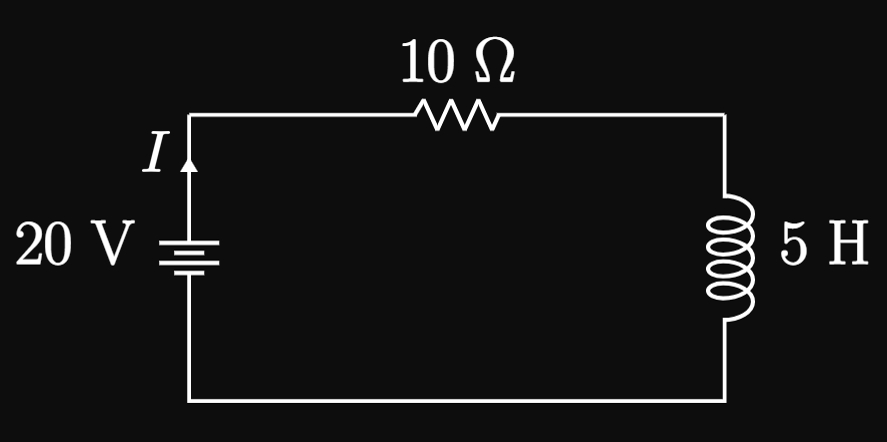
A battery of electromotive force \(20\) volts is connected to a circuit with resistance \(10\) ohms
and inductance \(5\) henries (Figure 1).
Let \(I\) be the circuit's current, which changes with time \(t,\) measured in seconds.
The voltage drops are \(10 I\) across the resistor and \(5 \, \textderiv{I}{t}\) across the inductor.
Applying one of Kirchhoff's Laws gives the differential equation
\[20 - 10I - 5 \deriv{I}{t} = 0 \pd\]
The initial current is \(0\) amps.
Using Euler's Method with step size \(h = 0.25,\)
approximate the current after \(1\) second has elapsed.
What is the current after a very long time (that is, as \(t \to \infty\))?
The particular solution to the differential equation turns out to be
\[I(t) = 2 \par{1 - e^{-2t}} \pd\]
Verify this result.
Does this function make physical sense?
A ball of mass \(m\) is dropped from rest.
Let \(v(t)\) be the ball's velocity at any time \(t.\)
The ball experiences two forces:
its weight, \(mg\) (where \(g\) is the acceleration due to gravity),
and an upward drag force, \(b v(t)\)
(where \(b\) is a drag coefficient).
By Newton's Second Law, the ball satisfies the differential equation
\[m \deriv{v}{t} + bv = mg \pd\]
Using an integrating factor, show that
\[v(t) = \frac{mg}{b} \par{1 - e^{-bt/m}} \pd\]
Terminal velocity, \(v_T,\)
is the maximum velocity of the ball.
Show that \(v_T = mg/b.\)
A duck swims back and forth along a river with acceleration given by
\(a^2 = 1 - 4v^2,\)
where \(v\) is the duck's velocity.
Let \(s\) be the duck's position from its nest in the river,
and take east to be the positive direction.
The duck begins at the nest and travels east with an initial velocity of \(1/2.\)
Determine the duck's position, velocity, and acceleration
as functions of time \(t \geq 0.\)
A student uses two iterations of Euler's Method, starting at \((k, Q)\) with equal step size \(h \gt 0,\)
to approximate \(y(k + h)\) and \(y(k + 2h),\) where \(y\) satisfies the differential equation
\[\deriv{y}{x} = \frac{x^3 - 4x}{y^2 + 1} \pd\]
Unfortunately, the student obtains trivial approximations on both iterations—that is,
\(y(k + h) \approx y_1 = Q\) and \(y(k + 2h) \approx y_2 = Q.\)
Find \(h\) and \(k,\) where \(k \geq 0.\)
The general solution to the family of second-order linear differential equations
\[a y'' + by' + cy = 0 \cma\]
for constant coefficients \(a, b, c \ne 0,\) is
\[y = K_1 e^{r_1x} + K_2 e^{r_2 x} \cma\]
where \(K_1\) and \(K_2\) are arbitrary constants and \(r_1 \ne r_2.\)
In terms of \(a,\) \(b,\) and \(c,\)
determine expressions for \(r_1\) and \(r_2.\)
Because the function \(e^{-x^2}\) has no elementary antiderivatives,
we define a new function—the error function, \(\erf x\)—such that
\[\int e^{-x^2} \di x = \frac{\sqrt \pi}{2} \erf x \pd\]
In terms of the error function, determine the general solution to the differential equation
\[
\sqrt{\deriv{y}{x}} = \frac{4y}{e^{2x^2}} + 2 e^{-2x^2} \pd
\]
An object oscillates in a damped system under a harmonic force.
If \(x(t)\) is the object's displacement, then it satisfies the second-order differential equation
\[m \derivOrder{x}{t}{2} + c \deriv{x}{t} + kx = F_0 \cos \omega t \cma\]
where \(F_0\) is the magnitude of the harmonic force, \(m\) is the mass, \(c\) is the damping constant,
and \(k\) is the system's stiffness, all of which are nonzero.
The differential equation has two independent solutions:
\(x_T(t)\) is the transient solution (the temporary, initial behavior),
and \(x_S(t)\) is the steady-state solution (the long-term behavior).
The complete solution to the differential equation is
\[x(t) = x_T(t) + x_S(t) \pd\]
It can be shown that the transient solution to the differential equation takes the form
\[x_T(t) = C e^{-\lambda t} \cos \par{\alpha t + \beta} \cma\]
where \(C,\) \(\lambda,\) \(\alpha,\) and \(\beta\) are nonzero constants with \(\lambda \gt 0.\)
Show that \(x_T(t) \to 0\) as \(t \to \infty.\)
What does this result mean?
The steady-state solution can be assumed to be of the form
\[x_S(t) = A \cos \omega t + B \sin \omega t \pd\]
Substitute this function into the differential equation to solve for \(A\) and \(B.\)
(Hint: Compare the coefficients of the sine and cosine terms.)
The amplitude of the object's displacement is \(X = \sqrt{A^2 + B^2}.\)
Using the result of part (b), find \(X.\)