Consider the region in the first quadrant bounded above by the hyperbola \(y = 1/x,\)
below by the \(x\)-axis, left by the line \(x = m,\) and right by the line \(x = 2m.\)
Prove that the area of the region is independent of \(m.\)
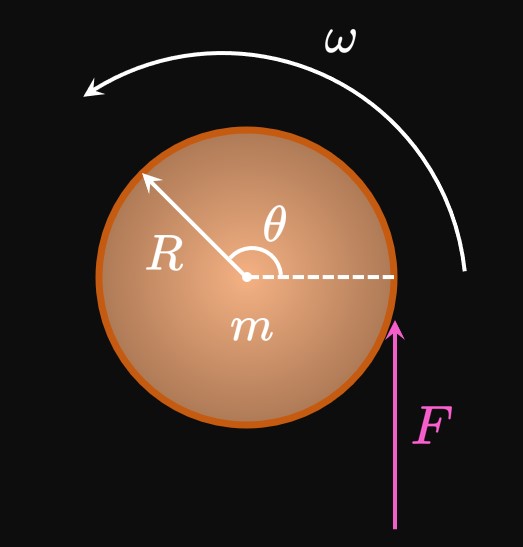
A constant force \(F\) is applied to a point on the rim of a circular, uniform, solid disk of mass \(m\) and radius \(R\)
(Figure 1).
This force supplies a constant angular acceleration of
\[\alpha = \frac{2F}{mR} \pd\]
The angular velocity, \(\omega,\) describes how fast the disk spins,
while the angular displacement, \(\theta,\) represents the angle by which a point on the rim has rotated.
If the disk starts from rest with no initial rotation, then derive an expression for \(\theta(t),\)
the disk's angular displacement as a function of time.
For any nonzero constant \(a,\) let
\[g(x) = \frac{x \sin x}{(x^2 + a^2) \ln (1 + \atan 9x)} \pd\]
For \(x \in (0, \pi),\) show that
\[0 \leq \int_0^\pi g(x) \di x \leq \int_0^\pi g(x) \csc x \di x \pd\]
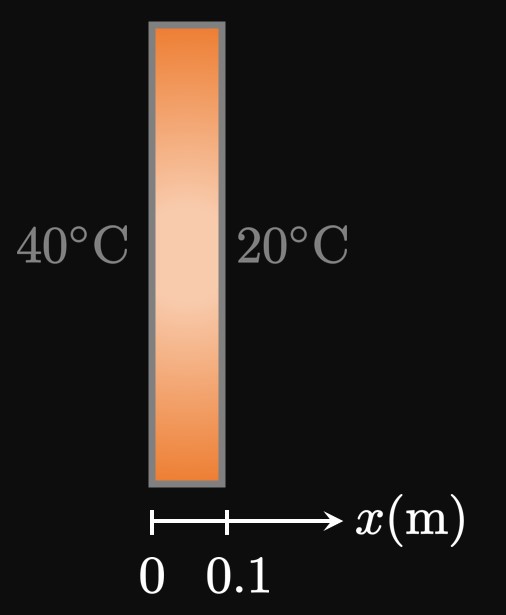
The left side of a uniform plane wall is maintained at \(40 \celcius,\)
while the right side is maintained at \(20 \celcius.\)
The wall is \(0.1\) meter thick and neither generates nor stores heat.
Let the \(x\)-axis be positioned such that \(x = 0\) is the left side and \(x = 0.1\)
is the right side.
(See Figure 2.)
By the heat conduction equation,
the wall's temperature \(T\) as a function of \(x\) satisfies the differential equation
\[\derivOrder{T}{x}{2} = 0 \pd\]
For \(0 \leq x \leq 0.1,\)
find \(T(x),\) the temperature distribution through the wall.
What is the temperature at the midpoint of the wall thickness—that is,
at \(x = 0.05 \ques\)
If the wall is made of a different material, such as one with a greater insulation,
then does the answer in part (b) change?
Let \(S\) be the region in the first quadrant bounded by the graph of \(y = \sqrt x\)
and the line \(x = m.\)
The value of \(m\) is increasing at a constant rate of \(3\) units per minute.
How quickly is the area of \(S\) increasing with time when \(m = 16 \ques\)
Let \(Q\) be a quantity that changes with time \(t\)
and whose value at \(t = 0\) is \(Q_0.\)
Suppose that \(Q(t)\) increases at a rate of \(f(t)\) and decreases at a rate of \(g(t),\)
where \(f\) and \(g\) are differentiable functions.
Prove that \(Q\) has a relative maximum at the critical number \(t = c\) when \(f'(c) \lt g'(c).\)
Let \(k\) and \(m\) be positive numbers.
Show that with \(n\) subintervals, an endpoint approximation
estimates
\(\int_m^{2m} \dd x/x^k\)
with an error bound given by
\[
\abs{E_n} \leq \frac{k}{2n m^{k - 1}} \pd
\]
This exercise examines the Weierstrass substitution,
famously called the world's sneakiest substitution.
Prove the trigonometric identities
\[
\sin x = \frac{2 \tan \frac{x}{2}}{1 + \tan^2 \frac{x}{2}}
\and \cos x = \frac{1 - \tan^2 \frac{x}{2}}{1 + \tan^2 \frac{x}{2}} \pd
\]
(Hint: Start with the double-angle identities for sine and cosine;
then use the Pythagorean identity \(1 + \tan^2 \theta\) \(= 1/\cos^2 \theta.\))
If \(t = \tan(x/2),\) then show that
\[\dd x = \frac{2}{t^2 + 1} \di t \pd\]
Use the substitution \(t = \tan(x/2)\) to evaluate
\[\int_0^{\pi/2} \frac{1}{1 + \sin x + \cos x} \di x \pd\]