Determine all the values of \(n\) such that the Intermediate Value Theorem does not apply to
\[f(x) = \sqrt[\Large 5n]{2x + 1}\]
on the closed interval \([-1, 0].\)
Calculate
\[\lim_{x \to \infty} \parbr{6x^4 \par{\sin^4 \frac{1}{x}} + \frac{1}{x^2} \par{\csc^2 \frac{1}{x}} - 3} \pd\]
[Hint: Let \(t = x \sin (1/x)\) and use the result of
Example 1.3-8.]
For constants \(a\) and \(b\) such that \(a \gt 1\) and \(b \gt 3,\)
let
\[p(x) = \frac{x^{4a} - 3x^4 + e}{x^{b/3} + 8x - 12} \pd\]
Determine the relationship between \(a\) and \(b\) for which \(\lim_{x \to \infty} p(x)\) is finite.
When disturbed, an object vibrates at its natural frequency,
\(\omega_n,\)
which depends on the object's material properties and structure.
But when a harmonic force of magnitude \(F \gt 0\) and frequency \(\omega\)
is continually applied to a vibrating object,
it eventually vibrates at the forced frequency \(\omega.\)
After several cycles, the object's position varies with time \(t\) according to
\(x(t) = A \cos \omega t.\)
The amplitude is
\[A = \frac{F/k}{\sqrt{1 - (\omega/\omega_n)^2}} \cma\]
where \(k\) and \(\omega_n\) are positive constants inherent to the object.
What happens to the amplitude as the forced frequency approaches the natural frequency—that is,
as \(\omega \to \omega_n^- \ques\)
(This concept is called resonance.)
By the methods of Chapter 3, it can be shown that
\[\lim_{x \to 0} \frac{\ln (x + e) - 1}{x} = \frac{1}{e} \pd\]
Evaluate
\[L = \lim_{t \to \infty} \parbr{3 t \ln \par{e + \frac{1}{t}} - 3t + \frac{9}{t}} \pd\]
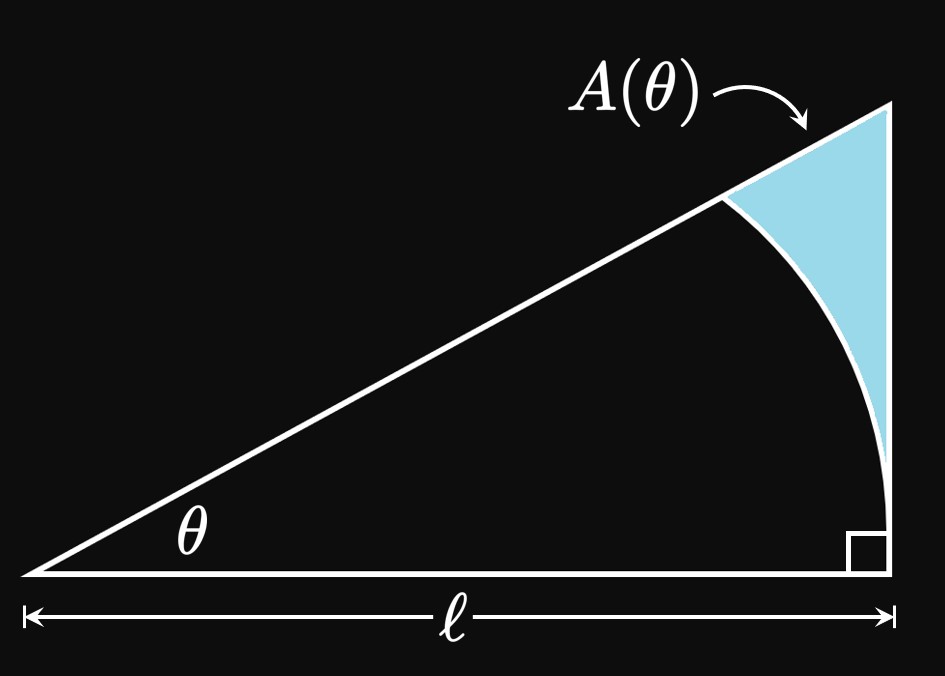
A circular sector that subtends an angle \(\theta\)
is inscribed in a right triangle whose base has length \(\ell,\)
as shown in Figure 1.
Let \(A(\theta)\) be the area of the region bounded between the sector and right triangle.
Determine an expression for \(A(\theta)\)
in terms of \(\ell\) and \(\theta.\)
Identify the domain of \(A(\theta).\)
Find and interpret \(\lim_{\theta \to (\pi/2)^-} A(\theta).\)
For the family of functions \(f(x) = Ce^{-Ax} \cos[g(x)],\)
where \(A\) and \(C\) are constants with \(A \gt 0,\) find \(\lim_{x \to \infty} f(x).\)
Assume that \(g\) is defined on \([N, \infty)\) for any real number \(N.\)