6.2: Trigonometric Integrals
In this section we investigate integrals with combinations of trigonometric functions. In doing so, we apply a variety of trigonometric properties and relationships using calculus. We discuss the following topics:
- Integrals with Sine and Cosine
- Integrals with Secants and Tangents
- Integrals with Cosecant and Cotangent
- Trigonometric Integrals with Products
Integrals with Sine and Cosine
We evaluate \(\int \sin^n x \cos x \di x \) by substituting \(u = \sin x\) because \(\dd u = \cos x \di x,\) thereby stripping the extra factor \(\cos x\) in the integrand. Similarly, we evaluate \(\int \cos^n x \sin x \di x \) using \(u = \cos x\) since \(\dd u = - \sin x \di x,\) eliminating the factor \(\sin x.\) Now let's devise a strategy to evaluate the families of integrals \[\int \sin^n x \di x \and \int \cos^n x \di x \] where \(n\) is a positive integer.
Odd \(n\) If \(n\) is odd, then \(n - 1\) is even. To evaluate \(\int \sin^n x \di x,\) we save an extra factor \(\sin x\) and use the Pythagorean identity to express \(\sin^{n - 1} x\) in terms of cosine. Then substituting \(u = \cos x\) strips the extra \(\sin x.\) Likewise, to evaluate \(\int \cos^n x \di x,\) we preserve an extra factor \(\cos x\) and use the Pythagorean identity to express \(\cos^{n - 1} x\) in terms of sine. The substitution \(u = \sin x\) then eliminates the extra \(\cos x.\)
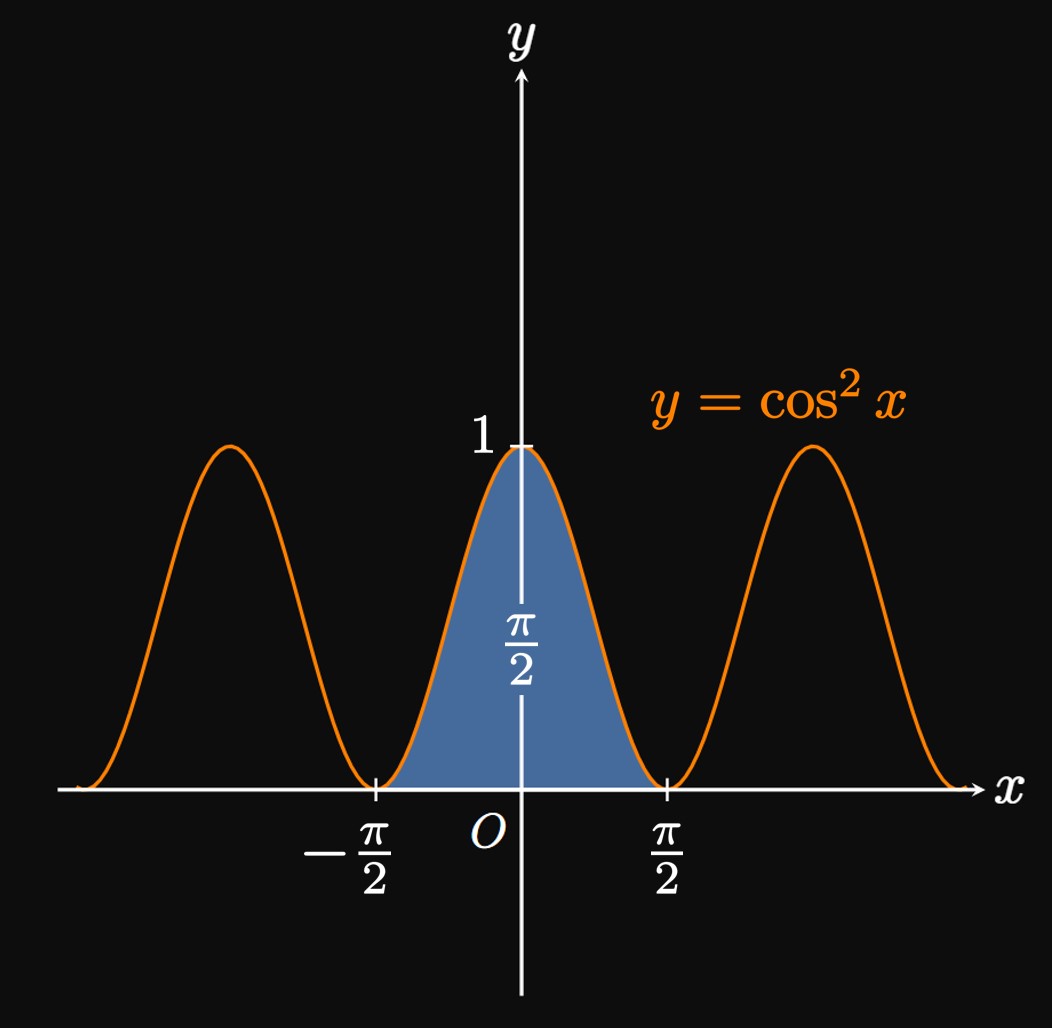
Even \(n\) Power-reduction formulas help us convert \(\sin^2 x\) and \(\cos^2 x\) into expressions of lower degree through the following equations: \begin{align} \sin^2 x &= \tfrac{1}{2} (1 - \cos 2x) \cma \label{eq:power-reduction-sin} \nl \cos^2 x &= \tfrac{1}{2} (1 + \cos 2x) \pd \label{eq:power-reduction-cos} \end{align} The expressions on the right are far easier to integrate. (We proved these equations in Example 0.8-15.) Thus, we evaluate \(\int \sin^n x \di x\) and \(\int \cos^n x \di x\) by using \(\eqref{eq:power-reduction-sin}\) and \(\eqref{eq:power-reduction-cos}\) as many times as necessary.
- If \(n\) is odd, then save an extra factor \(\sin x\) by writing \(\sin^n x\) as \(\sin^{n - 1} x \sin x.\) Use \(\sin^2 x = 1 - \cos^2 x\) to express \(\sin^{n - 1} x\) in terms of cosine: \[ \ba \int \sin^n x \di x &= \int \sin^{n - 1} x \sin x \di x \nl &= \int (1 - \cos^2 x)^{(n - 1)/2} \sin x \di x \pd \ea \] Then substitute \(u = \cos x.\)
- If \(n\) is even, then reduce the integral using \(\eqref{eq:power-reduction-sin}\) as necessary: \[ \int \sin^n x \di x = \int \parbr{\tfrac{1}{2} (1 - \cos 2x)}^{n/2} \di x \pd \]
- If \(n\) is odd, then save an extra factor \(\cos x\) by writing \(\cos^n x\) as \(\cos^{n - 1} x \cos x.\) Use \(\cos^2 x = 1 - \sin^2 x\) to express \(\cos^{n - 1} x\) in terms of sine: \[ \ba \int \cos^n x \di x &= \int \cos^{n - 1} x \cos x \di x \nl &= \int (1 - \sin^2 x)^{(n - 1)/2} \cos x \di x \pd \ea \] Then substitute \(u = \sin x.\)
- If \(n\) is even, then reduce the integral using \(\eqref{eq:power-reduction-cos}\) as necessary: \[ \int \cos^n x \di x = \int \parbr{\tfrac{1}{2} (1 + \cos 2x)}^{n/2} \di x \pd \]
Another common family of integrals is \(\int \sin^m x \cos^n x \di x,\) where \(m\) and \(n\) are positive integers. We evaluate these integrals similarly to how we evaluate \(\int \sin^n x \di x\) and \(\int \cos^n x \di x\)—by conserving a factor and performing a substitution, or by applying power-reduction formulas.
- If the power of sine is odd (\(m\) odd), then save an extra factor \(\sin x\) and use \(\sin^2 x = 1 - \cos^2 x\) to express the remaining factors in terms of cosine: \[ \ba \int \sin^m x \cos^n x \di x &= \int \sin^{m - 1} x \cos^n x \sin x \di x \nl &= \int (1 - \cos^2 x)^{(m - 1)/2} \cos^n x \sin x \di x \pd \ea \] Then substitute \(u = \cos x.\)
- If the power of sine is even and the power of cosine is odd (\(m\) even, \(n\) odd), then save an extra factor \(\cos x\) and use \(\cos^2 x = 1 - \sin^2 x\) to express the remaining factors in terms of sine: \[ \ba \int \sin^m x \cos^n x \di x &= \int \sin^m x \cos^{n - 1} x \cos x \di x \nl &= \int \sin^m x (1 - \sin^2 x)^{(n - 1)/2} \cos x \di x \pd \ea \] Then substitute \(u = \sin x.\)
- If the powers of sine and cosine are both even (\(m\) and \(n\) both even), then use \(\sin^2 x = 1 - \cos^2 x\) to express the integrand in terms of cosine: \[ \ba \int \sin^m x \cos^n x \di x &= \int (\sin^2 x)^{m/2} \cos^n x \di x \nl &= \int (1 - \cos^2 x)^{m/2} \cos^n x \di x \pd \ea \] Then use \(\eqref{eq:power-reduction-cos}\) to reduce the integral.
Integrals with Secants and Tangents
The next family of integrals we explore is \(\int \sec^m x \tan^n x \di x,\)
where \(m\) and \(n\) are positive integers.
Recall that \(\textderiv{}{x} (\tan x) = \sec^2 x.\)
Accordingly, one option is to conserve an extra factor \(\sec^2 x\) in the integrand,
express the remaining secants in terms of tangent (using \(\tan^2 x =\)
- If the power of secant is even (\(m\) even), then preserve an extra factor \(\sec^2 x.\) Use \(\sec^2 x = \tan^2 x + 1\) to express the remaining factors in terms of tangent: \[ \ba \int \sec^m x \tan^n x \di x &= \int \sec^{m - 2} x \tan^n x \sec^2 x \di x \nl &= \int (\tan^2 x + 1)^{(m - 2)/2} \tan^n x \sec^2 x \di x \pd \ea \] Then substitute \(u = \tan x.\)
- If the power of tangent is odd (\(n\) odd), then preserve an extra factor \(\sec x \tan x.\) Use \(\tan^2 x = \sec^2 x - 1\) to express the remaining factors in terms of secant: \[ \ba \int \sec^m x \tan^n x \di x &= \int \sec^{m - 1} x \tan^{n - 1} x \sec x \tan x \di x \nl &= \int \sec^{m - 1} x \par{\sec^2 x - 1}^{(n - 1)/2} \sec x \tan x \di x \pd \ea \] Then substitute \(u = \sec x.\)
A similar strategy enables us to evaluate \(\int \sec^n x \di x\) if \(n\) is a positive even integer, as shown below. But if \(n\) is odd, then no simple guideline exists; instead, evaluating the integral may require ingenuity with trigonometric identities or Integration by Parts.
Integrals with Cosecant and Cotangent
It turns out that \(\csc x\) is analogous to \(\sec x\) and \(\tan x\) is analogous to \(\cot x.\) For example, the identity \(\cot^2 x + 1 = \csc^2 x\) is akin to \(\tan^2 x + 1 = \sec^2 x.\) The derivatives of cosecant and cotangent are also similar to the derivatives of secant and tangent, respectively; recall that \(\textderiv{}{x} (\csc x)\) \(= -\csc x \cot x\) and \(\textderiv{}{x} (\cot x)\) \(= -\csc^2 x.\) Therefore, if \(m\) and \(n\) are positive integers, then we evaluate \(\int \csc^m x \cot^n x \di x\) nearly identically to how we evaluate \(\int \sec^m x \tan^n x \di x.\) Let's therefore take inspiration from our strategy for Integrals with Secants and Tangents.
- If the power of cosecant is even (\(m\) even), then preserve an extra factor \(\csc^2 x.\) Use \(\csc^2 x = \cot^2 x + 1\) to express the remaining factors in terms of cotangent: \[ \ba \int \csc^m x \cot^n x \di x &= \int \csc^{m - 2} x \cot^n x \csc^2 x \di x \nl &= \int (\cot^2 x + 1)^{(m - 2)/2} \cot^n x \csc^2 x \di x \pd \ea \] Then substitute \(u = \cot x.\)
- If the power of cotangent is odd (\(n\) odd), then preserve an extra factor \(\csc x \cot x.\) Use \(\cot^2 x = \csc^2 x - 1\) to express the remaining factors in terms of cosecant: \[ \ba \int \csc^m x \cot^n x \di x &= \int \csc^{m - 1} x \cot^{n - 1} x \csc x \cot x \di x \nl &= \int \csc^{m - 1} x (\csc^2 x - 1)^{(n - 1)/2} \csc x \cot x \di x \pd \ea \] Then substitute \(u = \csc x.\)
Trigonometric Integrals with Products
The next families of integrals we evaluate contain products of trigonometric functions, such as the family \(\int \sin mx \cos nx \di x.\) Whereas we could use Integration by Parts to evaluate these integrals, it is far better to convert these products to sums of trigonometric functions, which are much easier to integrate. The following trigonometric identities enable us to do so.
PROOF The addition and subtraction identities for sine are, respectively, \[ \ba \sin(A + B) &= \sin A \cos B + \cos A \sin B \cma \nl \sin(A - B) &= \sin A \cos B - \cos A \sin B \pd \ea \] Adding both equations gives \begin{align} \sin(A - B) + \sin(A + B) &= 2 \sin A \cos B \nonum \nl \implies \sin A \cos B &= \tfrac{1}{2} [\sin(A - B) + \sin(A + B)] \pd \eqlabel{eq:sincos} \end{align} Conversely, the addition and subtraction identities for cosine are, respectively, \[ \ba \cos(A + B) &= \cos A \cos B - \sin A \sin B \cma \nl \cos(A - B) &= \cos A \cos B + \sin A \sin B \pd \ea \] By adding both equations, we see \begin{align} \cos(A - B) + \cos(A + B) &= 2 \cos A \cos B \nonum \nl \implies \cos A \cos B &= \tfrac{1}{2} [\cos(A - B) + \cos(A + B)] \pd \eqlabel{eq:coscos} \end{align} Likewise, subtracting both identities for cosine gives \begin{align} \cos(A - B) - \cos(A + B) &= 2 \sin A \sin B \nonum \nl \implies \sin A \sin B &= \tfrac{1}{2} [\cos(A - B) - \cos(A + B)] \pd \eqlabel{eq:sinsin} \end{align} \[\qedproof\]
- \(\ds \int \cos 4x \cos 2x \di x\)
- \(\ds \int \sin 8x \cos 3x \di x\)
- \(\ds \int \sin 12 x \sin 20 x \di x\)
- By \(\eqref{eq:coscos},\) the integral becomes \[ \int \tfrac{1}{2} (\cos 2x + \cos 6x) \di x = \boxed{\tfrac{1}{4} \sin 2x + \tfrac{1}{12} \sin 6x + C} \]
- By \(\eqref{eq:sincos},\) the integral becomes \[ \int \tfrac{1}{2} \par{\sin 5x + \sin 11 x} \di x = \boxed{-\tfrac{1}{10} \cos 5x - \tfrac{1}{22} \cos 11 x + C} \]
- By \(\eqref{eq:sinsin},\) the integral becomes \[ \ba \int \tfrac{1}{2} [\cos(-8x) - \cos 32 x] \di x &= -\tfrac{1}{16} \sin(-8x) - \tfrac{1}{64} \sin 32 x + C \nl &= \boxed{\tfrac{1}{16} \sin 8x - \tfrac{1}{64} \sin 32 x + C} \ea \] where the last step is true because sine is odd and so \(\sin(-8x)\) \(= -\sin 8x.\)
We culminate this section by evaluating miscellaneous trigonometric integrals, which require ingenuity and apply the strategies we have discussed.
RECALL As we proceed into the following examples, let's remind ourselves of the antiderivatives of tangent, secant, cosecant, and cotangent, which we found in Section 4.4. The following information is essential to memorize.
| \(\ds \int \tan x \di x = \ln \abs{\sec x} + C\) | \(\ds \int \cot x \di x = \ln \abs{\sin x} + C\) |
| \(\ds \int \sec x \di x = \ln \abs{\sec x + \tan x} + C\) | \(\ds \int \csc x \di x = - \ln \abs{\csc x + \cot x} + C\) |
The result in Example 12 seems unorthodox. But this integral happens to appear in many applications of integration, as we will see in the next chapters.
Integrals with Sine and Cosine We evaluate integrals that contain sine and cosine factors by exploiting the identities \(\textderiv{}{x} (\sin x) = \cos x\) and \(\textderiv{}{x} (\cos x) = -\sin x.\) The following guidelines enable us to evaluate \(\int \sin^n x \di x\) if \(n\) is a positive integer.
- If \(n\) is odd, then save an extra factor \(\sin x\) by writing \(\sin^n x\) as \(\sin^{n - 1} x \sin x.\) Use \(\sin^2 x = 1 - \cos^2 x\) to express \(\sin^{n - 1} x\) in terms of cosine: \[ \ba \int \sin^n x \di x &= \int \sin^{n - 1} x \sin x \di x \nl &= \int (1 - \cos^2 x)^{(n - 1)/2} \sin x \di x \pd \ea \] Then substitute \(u = \cos x.\)
- If \(n\) is even, then reduce the integral using \(\eqref{eq:power-reduction-sin}\) as necessary: \[ \int \sin^n x \di x = \int \parbr{\tfrac{1}{2} (1 - \cos 2x)}^{n/2} \di x \pd \]
Likewise, we use the following guidelines in evaluating \(\int \cos^n x \di x.\)
- If \(n\) is odd, then save an extra factor \(\cos x\) by writing \(\cos^n x\) as \(\cos^{n - 1} x \cos x.\) Use \(\cos^2 x = 1 - \sin^2 x\) to express \(\cos^{n - 1} x\) in terms of sine: \[ \ba \int \cos^n x \di x &= \int \cos^{n - 1} x \cos x \di x \nl &= \int (1 - \sin^2 x)^{(n - 1)/2} \cos x \di x \pd \ea \] Then substitute \(u = \sin x.\)
- If \(n\) is even, then reduce the integral using \(\eqref{eq:power-reduction-cos}\) as necessary: \[ \int \cos^n x \di x = \int \parbr{\tfrac{1}{2} (1 + \cos 2x)}^{n/2} \di x \pd \]
The following guidelines enable us to evaluate \(\int \sin^m x \cos^n x \di x.\)
- If the power of sine is odd (\(m\) odd), then save an extra factor \(\sin x\) and use \(\sin^2 x = 1 - \cos^2 x\) to express the remaining factors in terms of cosine: \[ \ba \int \sin^m x \cos^n x \di x &= \int \sin^{m - 1} x \cos^n x \sin x \di x \nl &= \int (1 - \cos^2 x)^{(m - 1)/2} \cos^n x \sin x \di x \pd \ea \] Then substitute \(u = \cos x.\)
- If the power of sine is even and the power of cosine is odd (\(m\) even, \(n\) odd), then save an extra factor \(\cos x\) and use \(\cos^2 x = 1 - \sin^2 x\) to rewrite the remaining factors in terms of sine: \[ \ba \int \sin^m x \cos^n x \di x &= \int \sin^m x \cos^{n - 1} x \cos x \di x \nl &= \int \sin^m x (1 - \sin^2 x)^{(n - 1)/2} \cos x \di x \pd \ea \] Then substitute \(u = \sin x.\)
- If the powers of sine and cosine are both even (\(m\) and \(n\) both even), then use \(\sin^2 x = 1 - \cos^2 x\) to express the integrand in terms of cosine: \[ \ba \int \sin^m x \cos^n x \di x &= \int (\sin^2 x)^{m/2} \cos^n x \di x \nl &= \int (1 - \cos^2 x)^{m/2} \cos^n x \di x \pd \ea \] Then use \(\eqref{eq:power-reduction-cos}\) to reduce the integral.
Integrals with Secants and Tangents The derivatives \(\textderiv{}{x} (\tan x)\) \(= \sec^2 x\) and \(\textderiv{}{x} (\sec x)\) \(= \sec x \tan x\) enable us to evaluate the family of integrals \(\int \sec^m x \tan^n x \di x\) as follows.
- If the power of secant is even (\(m\) even), then preserve an extra factor \(\sec^2 x.\) Use \(\sec^2 x = 1 + \tan^2 x\) to express the remaining factors in terms of \(\tan x \col \) \[ \ba \int \sec^m x \tan^n x \di x &= \int \sec^{m - 2} x \tan^n x \sec^2 x \di x \nl &= \int (1 + \tan^2 x)^{(m - 2)/2} \tan^n x \sec^2 x \di x \pd \ea \] Then substitute \(u = \tan x.\)
- If the power of tangent is odd (\(n\) odd), then preserve an extra factor \(\sec x \tan x.\) Use \(\tan^2 x = \sec^2 x - 1\) to express the remaining factors in terms of \(\sec x \col \) \[ \ba \int \sec^m x \tan^n x \di x &= \int \sec^{m - 1} x \tan^{n - 1} x \sec x \tan x \di x \nl &= \int \sec^{m - 1} x \par{\sec^2 x - 1}^{(n - 1)/2} \sec x \tan x \di x \pd \ea \] Then substitute \(u = \sec x.\)
To evaluate \(\int \sec^n x \di x\) if \(n\) is a positive even integer, we save an extra factor \(\sec^2 x\) and use \(\sec^2 x = \tan^2 x + 1\) to express the remaining factors in terms of tangent: \[ \ba \int \sec^n x \di x &= \int \sec^{n - 2} x \sec^2 x \di x \nl &= \int (\tan^2 x + 1)^{(n - 2)/2} \sec^2 x \di x \pd \ea \]
Integrals with Cosecant and Cotangent The derivatives \(\textderiv{}{x} (\cot x)\) \(= -\csc^2 x\) and \(\textderiv{}{x} (\csc x)\) \(= -\csc x \cot x\) enable us to evaluate the family of integrals \(\int \csc^m x \cot^n x \di x.\) We do so by employing a similar strategy from Integrals with Secants and Tangents; namely, \(\tan x\) is analogous to \(\cot x\) and \(\sec x\) is analogous to \(\csc x.\) We therefore use the following guidelines.
- If the power of cosecant is even (\(m\) even), then preserve an extra factor \(\csc^2 x.\) Use \(\csc^2 x = \cot^2 x + 1\) to express the remaining factors in terms of cotangent: \[ \ba \int \csc^m x \cot^n x \di x &= \int \csc^{m - 2} x \cot^n x \csc^2 x \di x \nl &= \int (\cot^2 x + 1)^{(m - 2)/2} \cot^n x \csc^2 x \di x \pd \ea \] Then substitute \(u = \cot x.\)
- If the power of cotangent is odd (\(n\) odd), then preserve an extra factor \(\csc x \cot x.\) Use \(\cot^2 x = \csc^2 x - 1\) to express the remaining factors in terms of cosecant: \[ \ba \int \csc^m x \cot^n x \di x &= \int \csc^{m - 1} x \cot^{n - 1} x \csc x \cot x \di x \nl &= \int \csc^{m - 1} x (\csc^2 x - 1)^{(n - 1)/2} \csc x \cot x \di x \pd \ea \] Then substitute \(u = \csc x.\)
Trigonometric Integrals with Products Trigonometric identities convert products of trigonometric functions into sums and differences, which are simple to integrate. We use the following equations: \begin{align} \sin A \sin B &= \tfrac{1}{2} [\cos(A - B) - \cos(A + B)] \eqlabel{eq:sinsin} \nl \cos A \cos B &= \tfrac{1}{2} [\cos(A - B) + \cos(A + B)] \eqlabel{eq:coscos} \nl \sin A \cos B &= \tfrac{1}{2} [\sin(A - B) + \sin(A + B)] \eqlabel{eq:sincos} \end{align}